
Author: Rajesh Sharma

  • Tablet Manufacturing Flow — Pharmaceutical Industry

    Tablet Manufacturing Flow — Pharmaceutical Industry

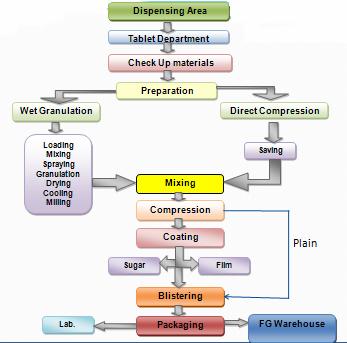
    Tablet Manufacturing Process – Complete Pharmaceutical Manufacturing Flow

    Tablet manufacturing is a systematic pharmaceutical process in which active pharmaceutical ingredients (APIs) and excipients are transformed into a high-quality, stable, and reproducible dosage form. Each stage of manufacturing is controlled through defined process parameters, in-process controls, GMP requirements, and quality standards.

    Pharmaceutical Tablet Manufacturing Flow

    Raw Material Dispensing → Sifting → Granulation / Direct Compression → Drying → Milling → Blending → Lubrication → Compression → Dedusting → Metal Detection → Coating → Inspection → Primary Packing → Secondary Packing → Finished Product Testing → QA Review → Batch Release

    Note: Some steps, such as granulation, drying, milling, and coating, are formulation-dependent.


    1. Raw Material Dispensing

    The manufacturing process begins with dispensing of approved and released raw materials according to the approved Batch Manufacturing Record (BMR).

    Typical materials include:

    • Active Pharmaceutical Ingredient (API)
    • Diluent/Filler
    • Binder
    • Disintegrant
    • Glidant
    • Lubricant
    • Coloring agents
    • Other functional excipients

    Key Controls

    • Material identity verification
    • Material status verification
    • Accurate weighing
    • Equipment status
    • Line clearance
    • Environmental conditions
    • Independent verification of critical materials

    2. Sifting / Sieving

    Raw materials are passed through a specified sieve or screen to remove lumps and control particle size.

    Purpose

    • Remove foreign particles and lumps
    • Improve material uniformity
    • Improve blending characteristics
    • Achieve the required particle-size distribution

    Sieve integrity and the specified mesh size should be verified before and after use, where applicable.


    3. Granulation

    Granulation may be used to improve flowability, compressibility, and content uniformity.

    Depending on the formulation, different manufacturing approaches may be used.

    Wet Granulation

    Dispensing → Sifting → Dry Mixing → Binder Addition → Wet Granulation → Drying → Milling

    Important parameters may include:

    • Binder concentration
    • Binder addition rate
    • Impeller speed
    • Chopper speed
    • Granulation time
    • Granulation endpoint
    • Wet mass characteristics

    Dry Granulation

    Dispensing → Sifting → Pre-Blending → Roller Compaction/Slugging → Milling

    Important parameters may include:

    • Roll pressure
    • Roll speed
    • Feed screw speed
    • Ribbon density
    • Milling parameters

    Direct Compression

    For suitable formulations:

    Dispensing → Sifting → Blending → Lubrication → Compression

    Direct compression eliminates the granulation and drying stages and requires excellent powder flow, compressibility, and blend uniformity.


    4. Drying

    In wet granulation, the wet granules are dried using equipment such as a Fluid Bed Dryer (FBD).

    The objective is to achieve the specified moisture content or Loss on Drying (LOD).

    Important Parameters

    • Inlet air temperature
    • Product temperature
    • Airflow
    • Drying time
    • Moisture/LOD
    • Drying endpoint

    Both under-drying and over-drying can negatively affect downstream processing and finished-product performance.


    5. Milling / Sizing

    Dried granules are milled or sized to achieve the desired particle-size distribution.

    Objectives

    • Break oversized granules
    • Improve flow properties
    • Achieve consistent particle size
    • Improve compression performance

    Key parameters include screen size, mill speed, feed rate, and equipment configuration.


    6. Blending

    The milled granules or powders are blended with the required excipients to obtain a homogeneous mixture.

    Critical Considerations

    • Blender type and capacity
    • Blender load
    • Mixing speed
    • Mixing time
    • Order of ingredient addition
    • Blend uniformity
    • Sampling locations

    Inadequate blending can result in content uniformity failures, while excessive blending may also affect product performance.


    7. Lubrication

    A lubricant, commonly magnesium stearate, is added during the final blending stage.

    The lubrication process must be carefully controlled because excessive lubrication can adversely affect:

    • Tablet hardness
    • Disintegration
    • Dissolution
    • Mechanical strength
    • Powder properties

    Therefore, lubrication time and mixing conditions should be established and validated.


    8. Tablet Compression

    The lubricated blend is compressed using a tablet compression machine to produce tablets of the required shape, size, weight, and strength.

    Important Compression Parameters

    • Machine speed
    • Feeder speed
    • Fill depth
    • Pre-compression force
    • Main compression force
    • Ejection force
    • Tablet weight
    • Tablet thickness

    Typical In-Process Controls

    • Appearance
    • Average tablet weight
    • Individual weight variation
    • Thickness
    • Hardness
    • Friability
    • Disintegration
    • Compression parameters

    The objective is to maintain consistent tablet quality throughout the compression operation.


    9. Tablet Dedusting

    Compressed tablets are passed through a tablet deduster to remove loose powder from the tablet surface.

    Effective dedusting helps improve:

    • Tablet appearance
    • Packing performance
    • Metal detection performance
    • Overall product cleanliness

    10. Metal Detection

    Tablets are passed through a metal detector to identify and reject tablets containing metallic contamination.

    The metal detector should be challenged using approved test standards at defined intervals to verify detection and rejection functionality.


    11. Tablet Coating

    Where required, compressed tablet cores are coated to provide functional or aesthetic benefits.

    Common coating types include:

    • Film coating
    • Enteric coating
    • Functional coating
    • Sugar coating

    Important Coating Parameters

    • Pan speed
    • Inlet air temperature
    • Product/bed temperature
    • Exhaust temperature
    • Spray rate
    • Atomization air pressure
    • Gun-to-bed distance
    • Coating suspension properties
    • Target weight gain

    Proper control of coating parameters is essential to achieve uniform appearance and desired product performance.


    12. Tablet Inspection

    Tablets are inspected to identify visible defects and ensure compliance with established specifications.

    Common defects include:

    • Capping
    • Lamination
    • Picking
    • Sticking
    • Chipping
    • Cracking
    • Mottling
    • Color variation
    • Broken tablets
    • Incorrect embossing or debossing

    Defective tablets should be appropriately segregated and handled according to approved procedures.


    13. Primary Packaging

    After successful manufacturing and inspection, tablets are packed using an approved primary packaging system.

    Common Packaging Systems

    Blister Packaging

    Tablet → Forming → Tablet Feeding → Sealing → Coding → Cutting

    Bottle Packaging

    Tablet → Counting → Filling → Desiccant, if applicable → Capping → Sealing → Coding

    Important controls include:

    • Line clearance
    • Correct packaging material
    • Correct product
    • Batch number
    • Manufacturing date
    • Expiry date
    • MRP, where applicable
    • Pack configuration
    • Reconciliation

    14. Secondary Packaging

    Primary packs are transferred to secondary packaging operations.

    Typical activities include:

    • Cartoning
    • Leaflet insertion
    • Labeling
    • Shipper packing
    • Serialization, where applicable
    • Aggregation, where applicable

    Packaging line clearance and reconciliation are critical to prevent product and packaging mix-ups.


    15. Finished Product Testing

    Representative samples are submitted to Quality Control for testing according to the approved specification and applicable pharmacopoeial requirements.

    Depending on the product, testing may include:

    • Description/Appearance
    • Identification
    • Assay
    • Dissolution
    • Disintegration
    • Content Uniformity
    • Related Substances/Impurities
    • Friability, where applicable
    • Water/LOD, where applicable
    • Microbiological testing, where applicable

    16. QA Review and Batch Release

    Quality Assurance performs a comprehensive review of the batch documentation before final product release.

    The review may include:

    • Batch Manufacturing Record
    • Batch Packaging Record
    • In-process control results
    • QC analytical results
    • Deviations
    • Change controls
    • OOS/OOT investigations, where applicable
    • Yield reconciliation
    • Environmental monitoring, where applicable
    • Equipment and cleaning status

    After satisfactory completion of the review and compliance with established requirements, the batch can be released by the authorized Quality function.


    Critical Quality and Process Considerations

    Successful tablet manufacturing requires control of both Critical Quality Attributes (CQAs) and Critical Process Parameters (CPPs).

    Typical CQAs

    • Assay
    • Content Uniformity
    • Dissolution
    • Disintegration
    • Tablet Weight
    • Hardness
    • Friability
    • Thickness
    • Appearance
    • Related Substances

    Typical CPPs

    • Mixing time and speed
    • Granulation endpoint
    • Drying temperature and endpoint
    • Milling parameters
    • Lubrication time
    • Compression force
    • Machine speed
    • Coating spray rate
    • Inlet/product temperature
    • Packaging parameters

    Common Tablet Manufacturing Problems

    Manufacturing StageCommon ProblemPossible Factors
    GranulationPoor granulesBinder, endpoint, process parameters
    DryingHigh/low moistureDrying conditions, endpoint
    MillingVariable particle sizeScreen, speed, feed rate
    BlendingPoor uniformityMixing time, segregation, sampling
    LubricationPoor dissolutionExcessive lubrication
    CompressionWeight variationFeeding, speed, powder flow
    CompressionCapping/LaminationGranule properties, compression parameters
    CompressionSticking/PickingMoisture, formulation, tooling
    CoatingMottlingSpray, drying, suspension properties
    CoatingRough surfaceSpray rate, atomization, drying
    PackingMix-upLine clearance/reconciliation

    GMP Perspective

    Tablet manufacturing should be performed in accordance with applicable GMP requirements, approved procedures, validated processes, qualified equipment, and documented controls.

    The fundamental objective is:

    Right Material + Right Process + Right Parameters + Right Controls + Right Documentation = Consistent Product Quality

    A robust tablet manufacturing process is not simply about producing tablets; it is about consistently producing tablets that meet predefined quality, safety, efficacy, and regulatory requirements.

    Conclusion

    Tablet manufacturing is an integrated process involving material control, powder/granule processing, blending, compression, coating, packaging, testing, and QA release. Effective control of process parameters, equipment, materials, personnel, and documentation is essential for achieving consistent product quality.

    For pharmaceutical manufacturing professionals, understanding the relationship between Material Attributes → Process Parameters → Critical Quality Attributes is fundamental to achieving process robustness and operational excellence.

  • Lean Manufacturing – toward excellence

    Transforming Pharmaceutical Manufacturing Through Continuous Improvement

    Lean Manufacturing is a systematic approach to improving operational performance by maximizing customer value while minimizing waste, variation, delays, and non-value-added activities.

    In pharmaceutical manufacturing, Lean Manufacturing helps organizations improve productivity, quality, compliance, equipment utilization, manufacturing lead time, cost, and employee effectiveness without compromising patient safety or regulatory requirements.

    Simple Definition

    Lean Manufacturing means creating maximum value with minimum waste while maintaining quality, compliance, safety, and consistency.

    Lean is not simply about reducing manpower or cutting costs. It is about improving the way work is performed by identifying problems, eliminating unnecessary activities, standardizing processes, and creating a culture of continuous improvement.


    Why Lean Manufacturing Is Important in Pharma

    Pharmaceutical manufacturing involves highly controlled processes, extensive documentation, equipment qualification, cleaning requirements, changeovers, material movement, quality checks, and regulatory controls.

    These activities are necessary, but there can still be significant opportunities to eliminate unnecessary waiting, movement, rework, delays, inefficient processes, equipment losses, and other forms of waste.

    Lean Manufacturing can help pharmaceutical organizations achieve:

    • Higher productivity
    • Better OEE
    • Reduced manufacturing cycle time
    • Reduced changeover time
    • Improved equipment utilization
    • Reduced rejection and rework
    • Better yield
    • Reduced process losses
    • Improved manpower productivity
    • Better material flow
    • Reduced waiting time
    • Improved schedule adherence
    • Improved workplace organization
    • Better problem-solving culture
    • Sustainable cost improvement

    Important Principle

    Lean should never mean compromising GMP, product quality, patient safety, data integrity, or regulatory requirements.

    Instead:

    Lean + GMP + Quality by Design + Data Integrity = Sustainable Pharmaceutical Operational Excellence


    The 5 Principles of Lean Manufacturing

    Lean Manufacturing is generally built around five fundamental principles.

    1. Identify Value

    Value is defined from the customer’s perspective.

    In pharmaceuticals, the ultimate customer is the patient, supported by healthcare providers and other stakeholders.

    Activities that contribute directly or indirectly to delivering a safe, effective and compliant product should be understood clearly.

    The first question should be:

    What activities actually add value, and what activities are necessary but non-value-added?


    2. Map the Value Stream

    Value Stream Mapping (VSM) is used to visualize the complete flow of:

    Material + Information + Process + People

    from the beginning to the end of a process.

    For example, a tablet manufacturing value stream may include:

    Dispensing → Sifting → Granulation → Drying → Milling → Blending → Compression → Coating → Packing

    The process should be analyzed for:

    • Processing time
    • Waiting time
    • Queue time
    • Material movement
    • Quality hold time
    • Equipment availability
    • Changeover
    • Documentation delays
    • Sampling and testing time
    • Batch release dependencies

    The objective is to identify where time and resources are being lost.


    3. Create Flow

    Once waste has been identified, the next objective is to improve process flow.

    A good process should move smoothly from one stage to another with minimum interruption.

    For example:

    Poor Flow

    Material → Waiting → QA dependency → Movement → Waiting → Machine unavailable → Processing

    Improved Flow

    Material → Processing → In-process control → Next process → Processing

    In pharmaceutical manufacturing, flow must always be designed within validated processes and GMP requirements.


    4. Establish Pull

    A Pull System means production and material movement are driven by actual downstream requirements rather than unnecessary overproduction.

    Examples include:

    • Kanban
    • Supermarket systems
    • Controlled WIP
    • Replenishment systems

    In a pharmaceutical environment, pull principles can support better control of:

    • Packaging materials
    • Components
    • WIP
    • Consumables
    • Production sequencing

    5. Pursue Perfection

    Lean Manufacturing is based on continuous improvement.

    After one improvement is completed, the organization should ask:

    What can we improve next?

    This creates a continuous improvement cycle:

    Identify → Measure → Analyze → Improve → Standardize → Monitor → Improve Again


    The 8 Wastes of Lean Manufacturing

    A commonly used Lean framework is TIMWOODS.

    T — Transportation

    Unnecessary movement of materials, components or products.

    Pharma Example

    Moving granules multiple times between areas because of poor process layout.

    Improvement

    Optimize material flow and equipment/process layout while maintaining segregation and GMP requirements.


    I — Inventory

    Excess raw material, packaging material, WIP or finished goods.

    Example

    Large quantities of WIP waiting between manufacturing stages.

    Improvement

    Improve planning, process flow and batch scheduling.


    M — Motion

    Unnecessary movement by employees.

    Example

    Operators repeatedly walking to collect tools, documents or materials.

    Improvement

    Use workplace organization, 5S and point-of-use storage.


    W — Waiting

    Time spent waiting for:

    • Equipment
    • Material
    • QA/QC
    • Documentation
    • Maintenance
    • Line clearance
    • Approval
    • Laboratory results

    Improvement

    Identify the constraint and remove the underlying cause.


    O — Overproduction

    Producing more than required or earlier than required.

    Pharma Example

    Producing batches significantly ahead of demand without a clear business requirement.

    Risk

    • Inventory increase
    • Working capital increase
    • Storage requirements
    • Expiry risk

    O — Overprocessing

    Performing activities that do not provide additional value.

    Examples:

    • Duplicate manual recording
    • Unnecessary movement
    • Redundant checks
    • Repeated data entry

    However, regulatory or GMP-required controls must never be eliminated simply because they appear non-value-added.


    D — Defects

    Defects create:

    • Rejection
    • Rework
    • Investigation
    • Deviation
    • CAPA
    • Material loss
    • Time loss

    Examples:

    • Tablet defects
    • Weight variation
    • Dissolution failure
    • Packaging defects
    • Incorrect documentation

    The Lean objective is to move from detecting defects to preventing defects.


    S — Skills

    Failure to utilize employee knowledge and capability effectively.

    Examples:

    • Highly skilled operators performing only repetitive activities
    • Lack of problem-solving involvement
    • Poor training
    • No cross-functional improvement teams

    Improvement

    Develop employees through:

    • Training
    • Skill matrix
    • Kaizen
    • Problem-solving workshops
    • Cross-functional projects
    • Multi-skilling

    Major Lean Manufacturing Tools

    1. 5S

    5S creates an organized, clean and efficient workplace.

    5S

    Sort – Remove unnecessary items
    Set in Order – Arrange required items systematically
    Shine – Clean and inspect
    Standardize – Establish standards
    Sustain – Maintain the discipline

    Pharmaceutical Example

    A compression room can use 5S for:

    • Tool organization
    • Cleaning accessories
    • Change parts
    • Documents
    • Lubrication materials
    • Machine accessories

    5S can improve:

    Safety + Productivity + Visual Management + Equipment Reliability


    2. Kaizen

    Kaizen means continuous improvement through small, systematic improvements.

    Kaizen can involve operators, supervisors, engineers, QA, QC and other functions.

    Example

    Problem:

    Operators spend 15 minutes searching for change parts.

    Kaizen:

    Create designated locations and visual identification.

    Result:

    Search time reduced significantly.

    The important point is that Kaizen does not always require expensive automation.

    Small improvements, implemented consistently, can create significant results.


    3. Value Stream Mapping

    VSM provides a complete view of the process.

    It helps identify:

    • Process time
    • Waiting time
    • Inventory
    • Information flow
    • Bottlenecks
    • Constraints
    • Waste

    Basic Approach

    Current State Map → Identify Waste → Future State Map → Improvement Plan


    4. SMED

    SMED = Single-Minute Exchange of Die

    The objective is to reduce equipment changeover and setup time.

    In pharmaceutical manufacturing, SMED can be applied to:

    • Compression
    • Coating
    • Capsule filling
    • Blister packing
    • Cartoning
    • Liquid filling
    • Other manufacturing and packaging operations

    Example

    Changeover:

    120 minutes → 80 minutes

    Potential benefit:

    • More available production time
    • Higher OEE
    • Better schedule flexibility
    • Increased capacity

    SMED typically focuses on separating:

    Internal Activities
    Activities that require equipment to be stopped.

    External Activities
    Activities that can be completed while equipment is running.


    5. Poka-Yoke

    Poka-Yoke means mistake-proofing.

    The objective is to prevent errors before they occur.

    Examples:

    • Correct-part identification
    • Barcode verification
    • Machine interlocks
    • Sensor-based detection
    • Color/visual identification
    • Component verification

    The principle is:

    Prevent the error rather than detect the error later.


    6. Visual Management

    Visual Management makes the condition of a process immediately understandable.

    Examples:

    • Production boards
    • Status indicators
    • Floor markings
    • Tool identification
    • Machine status
    • KPI boards
    • Andon systems
    • Color coding

    A good visual management system allows a supervisor to understand the situation within seconds rather than searching through multiple reports.


    7. Standard Work

    Standard Work defines the best currently known way to perform an activity consistently.

    It can include:

    • Sequence of activities
    • Standard time
    • Critical process parameters
    • Safety requirements
    • Quality checkpoints
    • Documentation requirements

    In pharma, Standard Work must be aligned with:

    • Approved SOPs
    • BMR/BPR
    • Validated processes
    • GMP requirements

    8. Kanban

    Kanban is a visual system for controlling material replenishment and workflow.

    It can help control:

    • WIP
    • Packaging components
    • Consumables
    • Maintenance spares
    • Production supplies

    The objective is to provide the right material at the right time and in the right quantity.


    Lean and OEE

    Lean Manufacturing and OEE are closely connected.

    OEE = Availability × Performance × Quality

    Lean tools can attack the losses behind poor OEE.

    OEE LossLean Approach
    BreakdownTPM / Reliability
    ChangeoverSMED
    Minor stoppagesKaizen / Poka-Yoke
    Reduced speedProcess optimization
    RejectionRoot Cause / Six Sigma
    Startup lossesStandard Work

    Therefore:

    Improving OEE should not be treated as simply increasing machine speed. The objective is to systematically eliminate the losses affecting Availability, Performance and Quality.


    Lean + Six Sigma

    Lean and Six Sigma complement each other.

    Lean

    Focuses primarily on:

    Flow + Waste + Speed

    Six Sigma

    Focuses primarily on:

    Variation + Defects + Process Capability

    Together:

    Lean Six Sigma = Faster + Better + More Consistent Processes

    A pharmaceutical example:

    Problem: Low tablet compression productivity.

    Lean investigates:

    • Waiting
    • Changeover
    • Motion
    • Material flow
    • Minor stoppages

    Six Sigma investigates:

    • Process variation
    • Machine parameters
    • Material characteristics
    • Defect patterns
    • Process capability

    Together they provide a stronger improvement approach.


    Lean Problem-Solving Approach

    A practical Lean problem-solving cycle is:

    1. Identify the Problem

    Clearly define the problem using data.

    2. Measure

    Collect actual process information.

    3. Analyze

    Use:

    • Pareto
    • 5 Why
    • Fishbone
    • Process mapping
    • Trend analysis

    4. Identify Root Cause

    Distinguish between:

    Symptom → Immediate Cause → Root Cause → System Cause

    5. Implement Countermeasure

    Develop an effective corrective/improvement action.

    6. Verify Results

    Compare:

    Before vs After

    7. Standardize

    Update applicable:

    • SOP
    • Work instructions
    • Training
    • PM
    • Checklists
    • Process controls

    8. Sustain

    Monitor the KPI and ensure the improvement does not disappear.


    Lean Manufacturing in Pharmaceutical Production

    A practical Lean improvement project could look like this:

    Problem

    Compression machine changeover takes 150 minutes.

    Step 1 — Data Collection

    Break the changeover into individual activities.

    Step 2 — Classification

    Separate:

    Internal activities
    and
    External activities

    Step 3 — Waste Identification

    Identify:

    • Waiting
    • Searching
    • Cleaning delays
    • Tool movement
    • Documentation delays
    • Adjustment time

    Step 4 — Kaizen

    Implement:

    • Pre-staging
    • Tool identification
    • Standard sequence
    • Visual controls
    • Parallel activities
    • Improved checklist

    Step 5 — Result

    Changeover:

    150 min → 100 min

    Step 6 — Standardization

    Update the applicable controlled documents and train personnel.

    Step 7 — Sustain

    Track changeover performance through the production KPI system.


    Lean Manufacturing and GMP

    One of the most important principles for pharmaceutical organizations is:

    Never implement Lean at the expense of GMP or product quality.

    Lean improvement must consider:

    • Patient safety
    • Product quality
    • Data integrity
    • Validation
    • Qualification
    • Cleaning validation
    • Cross-contamination control
    • Traceability
    • Documentation
    • Regulatory requirements

    Before implementing an improvement, evaluate:

    Quality Risk + Compliance Impact + Validation Requirement + Business Benefit


    Lean Manufacturing Metrics

    A Lean program should be supported by measurable KPIs.

    Productivity

    • Output/hour
    • Units/operator-hour
    • Batch output
    • Labour productivity

    Quality

    • RFT %
    • Rejection %
    • Rework %
    • Deviation rate
    • Complaint rate

    Equipment

    • OEE
    • Availability
    • MTBF
    • MTTR
    • Breakdown hours

    Delivery

    • Schedule adherence
    • Lead time
    • Batch cycle time

    Cost

    • Cost/batch
    • Conversion cost
    • Material loss
    • Energy consumption

    Improvement

    • Kaizen implemented
    • Savings generated
    • Recurrence rate
    • Project completion
    • Sustained improvements

    Common Mistakes in Lean Implementation

    Lean initiatives can fail when organizations:

    ❌ Focus only on cost cutting
    ❌ Treat Lean as a one-time project
    ❌ Implement 5S without culture change
    ❌ Focus only on OEE numbers
    ❌ Ignore operators’ knowledge
    ❌ Solve symptoms instead of root causes
    ❌ Implement changes without standardization
    ❌ Ignore GMP and quality requirements
    ❌ Fail to measure sustainability
    ❌ Depend entirely on consultants

    Successful Lean transformation requires:

    Leadership + People + Process + Data + Discipline + Continuous Improvement


    Lean Manufacturing Success Formula

    A sustainable Lean culture can be represented as:

    Leadership

    ↓

    Employee Engagement

    ↓

    Standard Work

    ↓

    Visual Management

    ↓

    Problem Solving

    ↓

    Kaizen

    ↓

    Performance Measurement

    ↓

    Standardization

    ↓

    Continuous Improvement


    Final Takeaway

    Lean Manufacturing is not merely a collection of tools such as 5S, Kaizen or SMED.

    It is a mindset and management system that continuously asks:

    What creates value?

    What creates waste?

    Why does the waste exist?

    How can we eliminate the root cause?

    How can we make the improvement sustainable?

    For pharmaceutical manufacturing, the ultimate objective is to create operations that are:

    Safe + Compliant + High Quality + Reliable + Productive + Cost-effective + Continuously Improving

    Lean Manufacturing Philosophy

    “Do more value-added work, with less waste, less variation, less waiting and fewer defects — without compromising quality, GMP or patient safety.”


    PharmawithRajesh Perspective

    At PharmawithRajesh, Lean Manufacturing is viewed not simply as a cost-reduction methodology, but as a foundation for Pharmaceutical Operational Excellence.

    The real transformation happens when Lean principles move from training rooms to the shop floor, and employees begin identifying waste, solving problems, improving standards, and taking ownership of their processes.

    Learn • Apply • Improve • Lead

  • Overview of Operation Excellence

    Operational Excellence (Operational Excellence / OpEx) is a systematic approach to improving business operations continuously so that an organization can consistently deliver high quality, maximum productivity, lower cost, shorter lead time, strong compliance, and customer satisfaction.

    For a pharmaceutical manufacturing organization, Operational Excellence means:

    “Right product, right quality, right quantity, right time, right cost — consistently and compliantly.”

    1. Core Pillars of Operational Excellence

    PillarMain ObjectivePharma Example
    SafetyZero harmReduce machine-related incidents
    QualityRight-first-timeReduce deviations, OOS, rejects
    DeliveryMeet production planImprove schedule adherence
    CostReduce conversion costReduce manpower, material & energy losses
    ProductivityProduce more with same resourcesImprove batch output
    ComplianceMaintain GMP/data integrityALCOA+, SOP adherence
    PeopleBuild ownership & capabilitySkill matrix, training, Kaizen
    ReliabilityImprove equipment performanceReduce breakdowns
    Continuous ImprovementSustain improvementsKaizen, Lean, Six Sigma

    2. Operational Excellence Framework

    A simple way to understand OpEx is:

    Strategy → Process → People → Technology → Performance → Continuous Improvement

    Strategy

    Define business objectives:

    • Improve OEE
    • Reduce manufacturing cost
    • Improve RFT
    • Reduce deviations
    • Increase capacity
    • Improve productivity
    • Reduce cycle time

    Process

    Optimize how work is performed:

    • Standard Work
    • SOP optimization
    • Process mapping
    • Value Stream Mapping
    • Waste elimination
    • Line balancing

    People

    Develop employees to solve problems:

    • Training
    • Skill matrix
    • Ownership
    • Daily management
    • Problem-solving capability
    • Cross-functional teams

    Technology

    Use appropriate technology:

    • Automation
    • MES
    • Electronic BMR
    • SCADA
    • Digital dashboards
    • Predictive maintenance
    • Data analytics

    Performance

    Measure the process through KPIs.

    Typical manufacturing KPIs:

    OEE = Availability × Performance × Quality

    Other KPIs:

    • Production achievement %
    • RFT %
    • Batch cycle time
    • Yield %
    • Rejection %
    • Deviation rate
    • Changeover time
    • MTBF
    • MTTR
    • Schedule adherence
    • Cost/batch
    • Labour productivity

    3. Lean Manufacturing in Operational Excellence

    Lean is one of the major methodologies used for OpEx.

    The objective is to identify and eliminate waste.

    8 Wastes — TIMWOODS

    T — Transportation
    Unnecessary movement of materials.

    I — Inventory
    Excess raw material/WIP/finished goods.

    M — Motion
    Unnecessary movement of operators.

    W — Waiting
    Waiting for machine, material, QA approval, documents, etc.

    O — Overproduction
    Producing earlier or more than required.

    O — Overprocessing
    Doing unnecessary processing or checks.

    D — Defects
    Rejection, rework, deviations, failures.

    S — Skills
    Underutilization of employee knowledge and capability.


    4. Important OpEx Tools

    For a Production Head/Manager, these are particularly important:

    Lean Tools

    • 5S
    • Kaizen
    • VSM – Value Stream Mapping
    • Kanban
    • Poka-Yoke
    • Visual Management
    • Standard Work
    • SMED
    • JIT

    Problem-Solving Tools

    • 5 Why
    • Fishbone/Ishikawa
    • Pareto Analysis
    • CAPA
    • A3 Problem Solving
    • 8D
    • DMAIC

    Six Sigma

    Define → Measure → Analyze → Improve → Control

    Useful for reducing:

    • Process variation
    • Defects
    • Yield variability
    • Compression/filling variability
    • Machine performance variation

    5. Daily Management System

    A strong Operational Excellence culture usually starts with Daily Management.

    For a pharmaceutical production department, a daily meeting can cover:

    Yesterday

    • Planned vs actual production
    • OEE
    • Yield
    • Downtime
    • Deviations
    • Rejection
    • Breakdown
    • Manpower issues

    Today

    • Production plan
    • Machine availability
    • Material availability
    • QA/QC dependencies
    • Maintenance activities

    Tomorrow

    • Upcoming batches
    • Changeovers
    • Resource requirements
    • Potential risks

    Escalation

    Issues should be categorized:

    Level 1: Operator/Shift level
    ↓
    Level 2: Department level
    ↓
    Level 3: Cross-functional/HOD
    ↓
    Level 4: Management

    This prevents small problems from becoming major problems.


    6. OpEx Example — Tablet Compression

    Suppose a compression machine has:

    • Planned production: 1,000,000 tablets
    • Actual production: 850,000 tablets
    • Frequent feeder blockage
    • Slow machine speed
    • Long changeover
    • High rejection

    A traditional approach might simply ask:

    “Why didn’t we achieve the target?”

    Operational Excellence asks:

    “What is preventing the process from achieving its designed capability?”

    Then investigate:

    Loss → Data → Root Cause → Countermeasure → Standardization → Monitoring

    For example:

    Feeder movement slow

    ↓

    Check speed trend

    ↓

    Mechanical inspection

    ↓

    Identify root cause

    ↓

    Corrective action

    ↓

    Verify performance

    ↓

    Update PM/inspection checklist

    ↓

    Train operators

    ↓

    Monitor recurrence

    This converts a fire-fighting culture into a problem-solving culture.


    7. Operational Excellence vs Continuous Improvement

    They are related but not exactly the same.

    Continuous Improvement = continuously making processes better.

    Operational Excellence = creating a management system and culture where excellent performance becomes sustainable and repeatable.

    So:

    Kaizen is a tool. Lean is a methodology. Six Sigma is a methodology. Operational Excellence is the broader management philosophy/system that brings these together.


    8. OpEx Maturity Model

    You can evaluate a production department in five stages:

    LevelOrganization Behavior
    1. ReactiveFirefighting and breakdown response
    2. ControlledSOPs, KPIs and basic monitoring
    3. ProactiveRoot-cause analysis and preventive actions
    4. OptimizedLean, Six Sigma, automation, predictive analytics
    5. World-ClassData-driven, highly reliable, continuously improving culture

    The goal for a Production Head should be to move the organization:

    Reactive → Controlled → Proactive → Optimized → World-Class


    9. Operational Excellence for a Production Head

    If you are preparing for a Production Manager/Sr. Manager/Production Head role, I would focus on these 10 areas:

    1. OEE improvement
    2. Lean Manufacturing
    3. Six Sigma/DMAIC
    4. Cost reduction
    5. Capacity improvement
    6. Quality & GMP compliance
    7. Equipment reliability
    8. People productivity & engagement
    9. Digital manufacturing/data analytics
    10. Continuous Improvement culture

    A strong Production Head mindset

    Instead of:

    “Production target achieved.”

    Think:

    “Is the process stable, capable, compliant, cost-effective and sustainable?”

    That is the essence of Operational Excellence.