
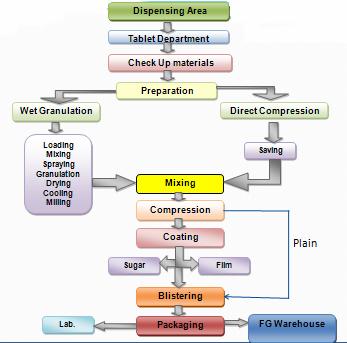
Tablet Manufacturing Process – Complete Pharmaceutical Manufacturing Flow
Tablet manufacturing is a systematic pharmaceutical process in which active pharmaceutical ingredients (APIs) and excipients are transformed into a high-quality, stable, and reproducible dosage form. Each stage of manufacturing is controlled through defined process parameters, in-process controls, GMP requirements, and quality standards.
Pharmaceutical Tablet Manufacturing Flow
Raw Material Dispensing → Sifting → Granulation / Direct Compression → Drying → Milling → Blending → Lubrication → Compression → Dedusting → Metal Detection → Coating → Inspection → Primary Packing → Secondary Packing → Finished Product Testing → QA Review → Batch Release
Note: Some steps, such as granulation, drying, milling, and coating, are formulation-dependent.
1. Raw Material Dispensing
The manufacturing process begins with dispensing of approved and released raw materials according to the approved Batch Manufacturing Record (BMR).
Typical materials include:
- Active Pharmaceutical Ingredient (API)
- Diluent/Filler
- Binder
- Disintegrant
- Glidant
- Lubricant
- Coloring agents
- Other functional excipients
Key Controls
- Material identity verification
- Material status verification
- Accurate weighing
- Equipment status
- Line clearance
- Environmental conditions
- Independent verification of critical materials
2. Sifting / Sieving
Raw materials are passed through a specified sieve or screen to remove lumps and control particle size.
Purpose
- Remove foreign particles and lumps
- Improve material uniformity
- Improve blending characteristics
- Achieve the required particle-size distribution
Sieve integrity and the specified mesh size should be verified before and after use, where applicable.
3. Granulation
Granulation may be used to improve flowability, compressibility, and content uniformity.
Depending on the formulation, different manufacturing approaches may be used.
Wet Granulation
Dispensing → Sifting → Dry Mixing → Binder Addition → Wet Granulation → Drying → Milling
Important parameters may include:
- Binder concentration
- Binder addition rate
- Impeller speed
- Chopper speed
- Granulation time
- Granulation endpoint
- Wet mass characteristics
Dry Granulation
Dispensing → Sifting → Pre-Blending → Roller Compaction/Slugging → Milling
Important parameters may include:
- Roll pressure
- Roll speed
- Feed screw speed
- Ribbon density
- Milling parameters
Direct Compression
For suitable formulations:
Dispensing → Sifting → Blending → Lubrication → Compression
Direct compression eliminates the granulation and drying stages and requires excellent powder flow, compressibility, and blend uniformity.
4. Drying
In wet granulation, the wet granules are dried using equipment such as a Fluid Bed Dryer (FBD).
The objective is to achieve the specified moisture content or Loss on Drying (LOD).
Important Parameters
- Inlet air temperature
- Product temperature
- Airflow
- Drying time
- Moisture/LOD
- Drying endpoint
Both under-drying and over-drying can negatively affect downstream processing and finished-product performance.
5. Milling / Sizing
Dried granules are milled or sized to achieve the desired particle-size distribution.
Objectives
- Break oversized granules
- Improve flow properties
- Achieve consistent particle size
- Improve compression performance
Key parameters include screen size, mill speed, feed rate, and equipment configuration.
6. Blending
The milled granules or powders are blended with the required excipients to obtain a homogeneous mixture.
Critical Considerations
- Blender type and capacity
- Blender load
- Mixing speed
- Mixing time
- Order of ingredient addition
- Blend uniformity
- Sampling locations
Inadequate blending can result in content uniformity failures, while excessive blending may also affect product performance.
7. Lubrication
A lubricant, commonly magnesium stearate, is added during the final blending stage.
The lubrication process must be carefully controlled because excessive lubrication can adversely affect:
- Tablet hardness
- Disintegration
- Dissolution
- Mechanical strength
- Powder properties
Therefore, lubrication time and mixing conditions should be established and validated.
8. Tablet Compression
The lubricated blend is compressed using a tablet compression machine to produce tablets of the required shape, size, weight, and strength.
Important Compression Parameters
- Machine speed
- Feeder speed
- Fill depth
- Pre-compression force
- Main compression force
- Ejection force
- Tablet weight
- Tablet thickness
Typical In-Process Controls
- Appearance
- Average tablet weight
- Individual weight variation
- Thickness
- Hardness
- Friability
- Disintegration
- Compression parameters
The objective is to maintain consistent tablet quality throughout the compression operation.
9. Tablet Dedusting
Compressed tablets are passed through a tablet deduster to remove loose powder from the tablet surface.
Effective dedusting helps improve:
- Tablet appearance
- Packing performance
- Metal detection performance
- Overall product cleanliness
10. Metal Detection
Tablets are passed through a metal detector to identify and reject tablets containing metallic contamination.
The metal detector should be challenged using approved test standards at defined intervals to verify detection and rejection functionality.
11. Tablet Coating
Where required, compressed tablet cores are coated to provide functional or aesthetic benefits.
Common coating types include:
- Film coating
- Enteric coating
- Functional coating
- Sugar coating
Important Coating Parameters
- Pan speed
- Inlet air temperature
- Product/bed temperature
- Exhaust temperature
- Spray rate
- Atomization air pressure
- Gun-to-bed distance
- Coating suspension properties
- Target weight gain
Proper control of coating parameters is essential to achieve uniform appearance and desired product performance.
12. Tablet Inspection
Tablets are inspected to identify visible defects and ensure compliance with established specifications.
Common defects include:
- Capping
- Lamination
- Picking
- Sticking
- Chipping
- Cracking
- Mottling
- Color variation
- Broken tablets
- Incorrect embossing or debossing
Defective tablets should be appropriately segregated and handled according to approved procedures.
13. Primary Packaging
After successful manufacturing and inspection, tablets are packed using an approved primary packaging system.
Common Packaging Systems
Blister Packaging
Tablet → Forming → Tablet Feeding → Sealing → Coding → Cutting
Bottle Packaging
Tablet → Counting → Filling → Desiccant, if applicable → Capping → Sealing → Coding
Important controls include:
- Line clearance
- Correct packaging material
- Correct product
- Batch number
- Manufacturing date
- Expiry date
- MRP, where applicable
- Pack configuration
- Reconciliation
14. Secondary Packaging
Primary packs are transferred to secondary packaging operations.
Typical activities include:
- Cartoning
- Leaflet insertion
- Labeling
- Shipper packing
- Serialization, where applicable
- Aggregation, where applicable
Packaging line clearance and reconciliation are critical to prevent product and packaging mix-ups.
15. Finished Product Testing
Representative samples are submitted to Quality Control for testing according to the approved specification and applicable pharmacopoeial requirements.
Depending on the product, testing may include:
- Description/Appearance
- Identification
- Assay
- Dissolution
- Disintegration
- Content Uniformity
- Related Substances/Impurities
- Friability, where applicable
- Water/LOD, where applicable
- Microbiological testing, where applicable
16. QA Review and Batch Release
Quality Assurance performs a comprehensive review of the batch documentation before final product release.
The review may include:
- Batch Manufacturing Record
- Batch Packaging Record
- In-process control results
- QC analytical results
- Deviations
- Change controls
- OOS/OOT investigations, where applicable
- Yield reconciliation
- Environmental monitoring, where applicable
- Equipment and cleaning status
After satisfactory completion of the review and compliance with established requirements, the batch can be released by the authorized Quality function.
Critical Quality and Process Considerations
Successful tablet manufacturing requires control of both Critical Quality Attributes (CQAs) and Critical Process Parameters (CPPs).
Typical CQAs
- Assay
- Content Uniformity
- Dissolution
- Disintegration
- Tablet Weight
- Hardness
- Friability
- Thickness
- Appearance
- Related Substances
Typical CPPs
- Mixing time and speed
- Granulation endpoint
- Drying temperature and endpoint
- Milling parameters
- Lubrication time
- Compression force
- Machine speed
- Coating spray rate
- Inlet/product temperature
- Packaging parameters
Common Tablet Manufacturing Problems
| Manufacturing Stage | Common Problem | Possible Factors |
|---|---|---|
| Granulation | Poor granules | Binder, endpoint, process parameters |
| Drying | High/low moisture | Drying conditions, endpoint |
| Milling | Variable particle size | Screen, speed, feed rate |
| Blending | Poor uniformity | Mixing time, segregation, sampling |
| Lubrication | Poor dissolution | Excessive lubrication |
| Compression | Weight variation | Feeding, speed, powder flow |
| Compression | Capping/Lamination | Granule properties, compression parameters |
| Compression | Sticking/Picking | Moisture, formulation, tooling |
| Coating | Mottling | Spray, drying, suspension properties |
| Coating | Rough surface | Spray rate, atomization, drying |
| Packing | Mix-up | Line clearance/reconciliation |
GMP Perspective
Tablet manufacturing should be performed in accordance with applicable GMP requirements, approved procedures, validated processes, qualified equipment, and documented controls.
The fundamental objective is:
Right Material + Right Process + Right Parameters + Right Controls + Right Documentation = Consistent Product Quality
A robust tablet manufacturing process is not simply about producing tablets; it is about consistently producing tablets that meet predefined quality, safety, efficacy, and regulatory requirements.
Conclusion
Tablet manufacturing is an integrated process involving material control, powder/granule processing, blending, compression, coating, packaging, testing, and QA release. Effective control of process parameters, equipment, materials, personnel, and documentation is essential for achieving consistent product quality.
For pharmaceutical manufacturing professionals, understanding the relationship between Material Attributes → Process Parameters → Critical Quality Attributes is fundamental to achieving process robustness and operational excellence.
Leave a Reply